Drone Survey Company
Roof and Building Survey
Houses, small blocks and older buildings looked at properly from the air, with a report a roofer or a surveyor can work from.
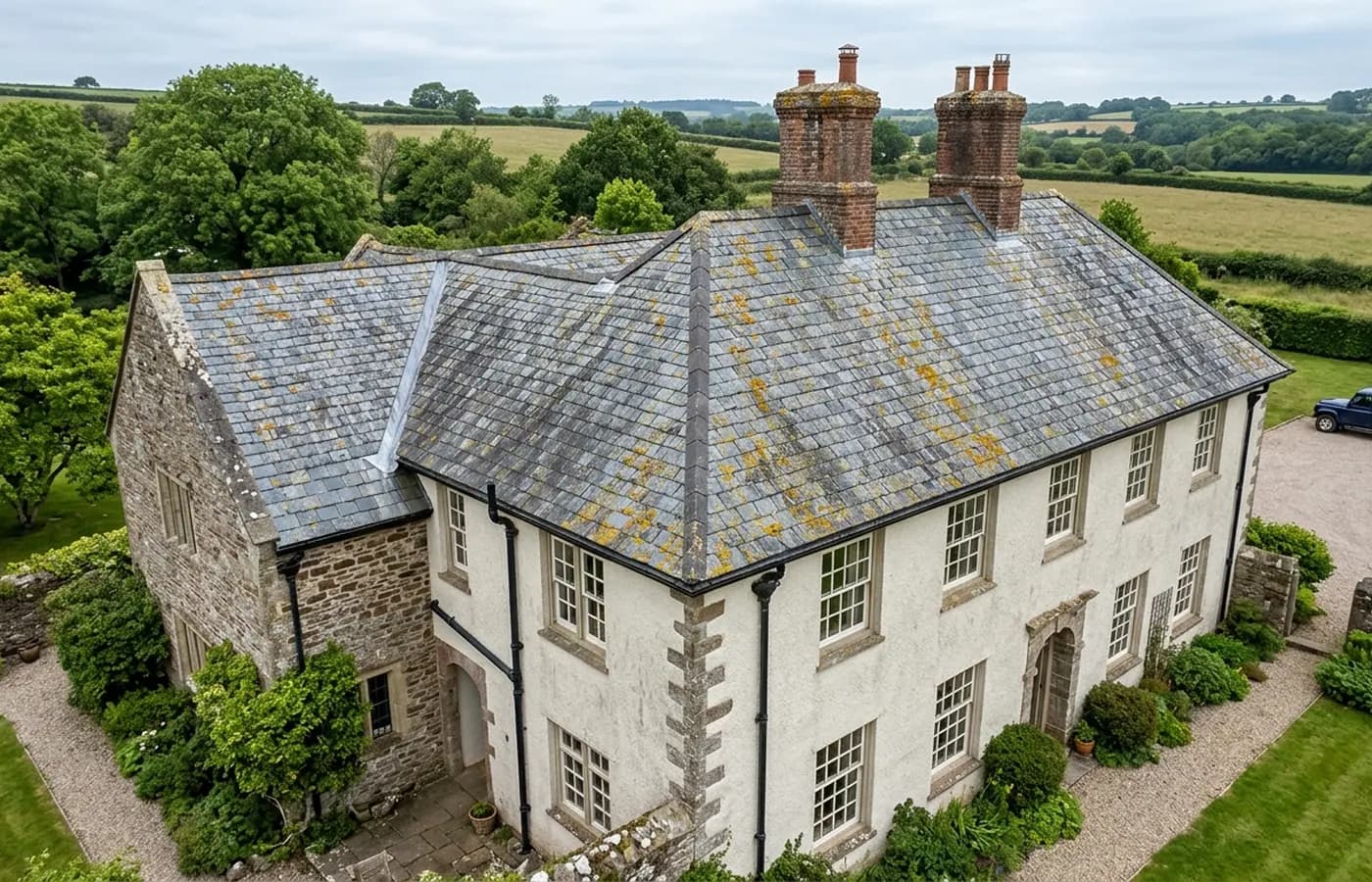
This is the survey most people mean when they ring. A house, a converted barn, a small block of flats or a listed building, with a roof somebody needs to understand before they spend money on it. It might be a purchase, a suspected leak, an insurance question, or a quote from a roofer that seems high and needs a second opinion.
The point of flying it rather than climbing it is not only safety. A camera at roof height, moving slowly along a ridge, sees the whole covering in one pass, including the slopes and valleys nobody puts a ladder against. On a tall or awkward building it produces a more complete picture than an access visit would, and it does it without anything leaning on the gutter.
It suits a homeowner, a landlord, a letting or managing agent, a solicitor chasing a point in a transaction, and roofers who want a set of images before they price the work.
What is included
- Every roof slope, ridge, hip and valley in overview and in close detail
- Chimney stacks, pots, flaunching, flashings and soakers
- Gutters, outlets, downpipes and the fascia line
- Elevations, render, pointing and any visible movement
- Any specific area you have asked about, covered on its own
- Written report inside 48 hours with the full resolution imagery
Older buildings and awkward roofs
The South West has a lot of building stock a ladder is the wrong tool for. Cob and thatch, three storey Georgian town houses with parapet gutters behind the front elevation, Victorian terraces with shared stacks and hidden valleys, converted agricultural buildings with long shallow slopes and no safe edge anywhere.
A survey flown at roof height reaches all of it without touching the fabric, which matters on a listed building where an access scaffold is both expensive and an application in its own right. The imagery also gives a conservation officer or a surveyor something to look at that does not require anybody to be up there.
Buying, selling and the gap in a homebuyer report
A standard homebuyer report is written from what a surveyor can see from the ground and from a loft hatch. Roofs come back with a caution and a recommendation to have them looked at properly, which is exactly where this survey fits.
If you are buying, the imagery answers a question that otherwise gets settled by guessing, and it gives you something concrete if the price needs revisiting. If you are selling, it does the same job in reverse: a documented roof takes an unknown out of the negotiation.
On the day
How a roof and building runs
- Step 1
Describe the building
The address, the type of building, roughly how old it is and what has prompted the survey. A photograph from the ground helps but is not needed to price the job.
- Step 2
Fixed price and a date
Back comes one price with travel inside it and a date that suits the weather forecast rather than a slot that has to be moved twice.
- Step 3
The visit
Half an hour to an hour and a half on site for most houses. Neighbours get told what is happening if the flight path takes the aircraft near their boundary.
- Step 4
Review and report
Full resolution review at the desk, then a written report inside 48 hours with the images that support each finding.
Behind the work
Kit, cover and qualifications
CAA registered
Registered with the Civil Aviation Authority as an operator, with an Operator ID and a Flyer ID held. Ask for the numbers and you will get them before the visit.
A2 Certificate of Competency
The pilot holds an A2 CofC, the certificate that allows flying closer to uninvolved people than the default. There is no GVC, and this site says so rather than leaving you to guess.
Insured with Coverdrone
Commercial operations are insured with Coverdrone. If your site or your managing agent needs a certificate on file, it goes over with the quote rather than after the flight.
Two aircraft, one pilot
A DJI Mavic 4 Pro with a 100 megapixel Hasselblad camera for detail, and a DJI Mavic 2 Enterprise Advanced with a 640 by 512 radiometric thermal camera. Sam Hembury flies both himself.
Roof and building
Roof and Building Survey questions
- Do you need to come inside?
- Usually not. Take off can be from the garden, the drive or a lane nearby, and the whole survey happens outside. If a loft is part of the question, say so at quote stage and we will agree what that adds.
- What about my neighbours?
- On a terrace or a tight plot the aircraft is kept over your property as far as the survey allows, and neighbours are told what is happening before the flight starts. It is a two minute conversation that avoids a much longer one afterwards.
- Can you tell me what a repair will cost?
- No, and a survey that quoted for its own findings would not be worth much. The report describes what is there and what it suggests, in terms a roofer can price from. Getting that price is a separate conversation with a roofer.
- Will the report satisfy my insurer or my solicitor?
- It gives them dated photographs and a written description of what was visible, which is what they usually ask for. It is not an insurance assessment or a legal opinion, and it does not pretend to be either.
Where
Roof and Building Survey across the South West
Also on this site
See how a job runs
Request a quote with Drone Survey Company
Tell us the address and what you need looking at. Sam Hembury will come back with a fixed price and the next available slot.